INNOVATION AND DESIGN THINKING LABORATORY COURSE

Home Project IDTL Course
Dr. Anita Kanavalli
Faculty Lead – Innovation & Design Thinking
Dr. Anita Kanavalli

Dr. Anita Kanavalli is a faculty member in the Department of Information Science and Engineering at Ramaiah Institute of Technology. She serves as the in-charge faculty for the Innovation and Design Thinking course, guiding students in developing creative problem-solving abilities, interdisciplinary collaboration, and innovation-driven thinking.

The course introduces students to the complete design thinking process, from understanding user needs to defining problems, generating ideas, developing prototypes, and testing solutions. It also encourages social entrepreneurship, innovation culture, stakeholder interaction, and practical problem framing.

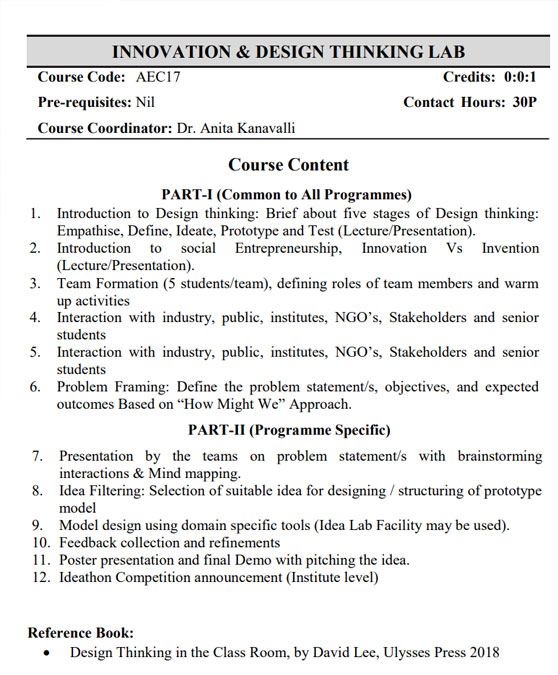
  • Course Code: AEC17 / AEC27
  • Credits: 0:0:1
  • Pre-requisites: Nil
  • Contact Hours: 30P
  • Course Coordinator: Dr. Anita Kanavalli
Innovation and Design Thinking
Course Highlights

A practice-oriented course designed to nurture creativity, teamwork, innovation, and prototype-based problem solving.

Design Thinking Process

Students are introduced to the five major stages of design thinking: Empathise, Define, Ideate, Prototype, and Test. These stages help learners understand real-world challenges and build meaningful solutions.

Innovation & Social Impact

The course provides exposure to social entrepreneurship, innovation versus invention, and the importance of solving community and industry problems through thoughtful design.

Team-Based Learning

Students work in teams, define individual roles, participate in brainstorming activities, interact with stakeholders, and refine their problem statements using the “How Might We” approach.

Prototype to Pitch

The course culminates in model design, feedback collection, refinement, poster presentation, final demonstration, and idea pitching, helping students move from concept to communication with confidence.

Course Structure

The Innovation and Design Thinking course blends theory, interaction, teamwork, and hands-on development.

Part I – Common Foundation
  • Introduction to design thinking and its five stages
  • Understanding innovation, invention, and social entrepreneurship
  • Formation of student teams and allocation of roles
  • Warm-up activities and collaborative engagement
  • Interaction with industries, institutes, NGOs, stakeholders, and senior students
  • Problem framing using the “How Might We” approach
Part II – Programme Specific
  • Team presentations on identified problem statements
  • Brainstorming and mind mapping sessions
  • Idea filtering and concept selection
  • Prototype/model design using domain-specific tools
  • Feedback collection and iterative refinement
  • Poster presentation, final demonstration, and idea pitching
  • Ideathon competition at institute level

Reference Book: Design Thinking in the Class Room, by David Lee, Ulysses Press, 2018.